
I didn’t realize I was running until I physically couldn’t stop. It wasn’t the kind of running that gets you a medal or a runner’s high. It was that low-level, vibration-in-your-teeth anxiety that comes from chasing metrics that don’t actually matter.
You know the feeling. The infinite scroll of the mind. The sensation that if you aren’t optimizing every second, you’re falling behind. We live in an era that worships speed. Move fast and break things. Scale or die. Hustle until your eyes bleed.
I bought into it. For years. I treated my life like a startup that needed to pivot every quarter. My wardrobe was disposable, my attention span was fractured, and my definition of “value” was entirely external.
Then, the crash came. Not a market crash. A personal one. A burnout so quiet and gray that I almost missed it. I found myself standing in the middle of a terminal at Heathrow airport, staring at a departure board, feeling absolutely nothing. I was wearing a pair of “tech-fabric” sneakers that promised maximum efficiency, and I felt completely unmoored from the earth.
That was the moment I decided to stop running. I decided to start walking. And to do that, I needed to change what was on my feet.
Gravity
We talk a lot about “mindset” in this space. We intellectualize resilience. We treat our brains like computers that just need a software update.
But we forget that we are biological entities. We are tactile creatures. The way you interact with the physical world dictates how your mind processes reality. If you surround yourself with cheap, disposable, synthetic things, your thoughts tend to become cheap, disposable, and synthetic.
I started looking for anchors. I wanted things that had weight. Things that had history. Things that weren’t screaming for attention.
This wasn’t about “retail therapy.” It was about recalibration.
I realized that “Quiet Luxury” is a terrible marketing term. It’s not about luxury. It’s about silence. It’s about the absence of noise. In a world that is constantly shouting at you to buy, to look, to click, the most radical act of rebellion is to choose something that whispers.
That’s when I circled back to Italian craftsmanship. Not the flashy stuff. Not the logos that look like billboards. The real stuff.
I went back to Tod’s.
The Philosophy of the Driver
It sounds trivial, doesn’t it? To pin a philosophical shift on a pair of shoes or a leather bag. But hear me out.
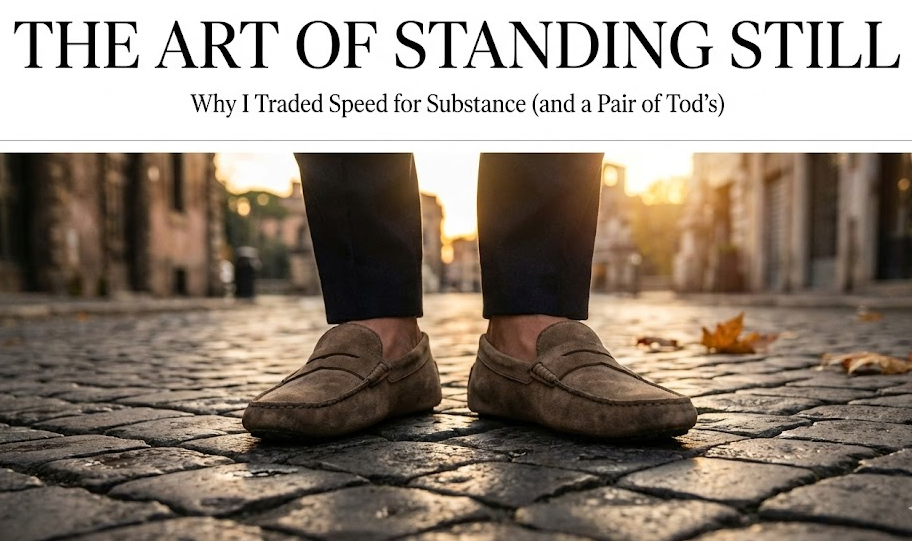
There is a specific philosophy behind a brand like Tod’s that resonates with where I am right now. It’s the philosophy of the Gommino. The driving shoe.
Think about the intent of a driving shoe. It’s designed for control. It’s designed for feeling the feedback of the machine through the sole of your foot. It connects you to the journey. It isn’t a running shoe. It isn’t a hiking boot designed to conquer a mountain. It is a shoe designed for navigating a path with precision and grace.
When I bought my first pair of Tod’s loafers in years, I noticed something immediately. The smell. That visceral, earthy scent of real leather that hasn’t been chemically blasted into submission. It smells like a workshop, not a factory.
The quality of your tools determines the quality of your work. And your clothes are the tools you use to interface with the world.
I slipped them on. They didn’t need “breaking in.” They just fit. And for the first time in a long time, I felt the ground. I felt heavy, in a good way. Grounded.
The Long Walk (A Practical Framework)
Here is the life hack I promised, the one that pulled me out of that airport burnout.
Stop dressing for the life you think you should have, and dress for the pace you want to set.
If you dress like you’re ready to sprint, your nervous system anticipates a race. If you dress with intention, with materials that age and patina rather than degrade, you tell your brain that you are in this for the long haul.
I started wearing my Tod’s on days when the pressure was highest. Days when I had to negotiate tough contracts or deliver difficult news. Why? Because they forced me to slow down my walk.
You cannot rush in a Loafer. You stride. You pace.
I paired this with their leather goods. I picked up a bag—not a “smart backpack” with forty charging ports, but a simple, beautifully constructed leather bag. It holds less. And that is the point. It forced me to curate what I carry. Do I really need three laptops and a tangle of cables? Or do I need a notebook, a pen, and a clear head?
This is the essence of essentialism. It’s not about having nothing. It’s about having the right things.
The resilience I talk about on this blog isn’t about being hard. It isn’t about being bulletproof. Real resilience is distinct from toughness. Toughness breaks; resilience bends. Leather bends. It takes the shape of the wearer. It records your history in its creases.
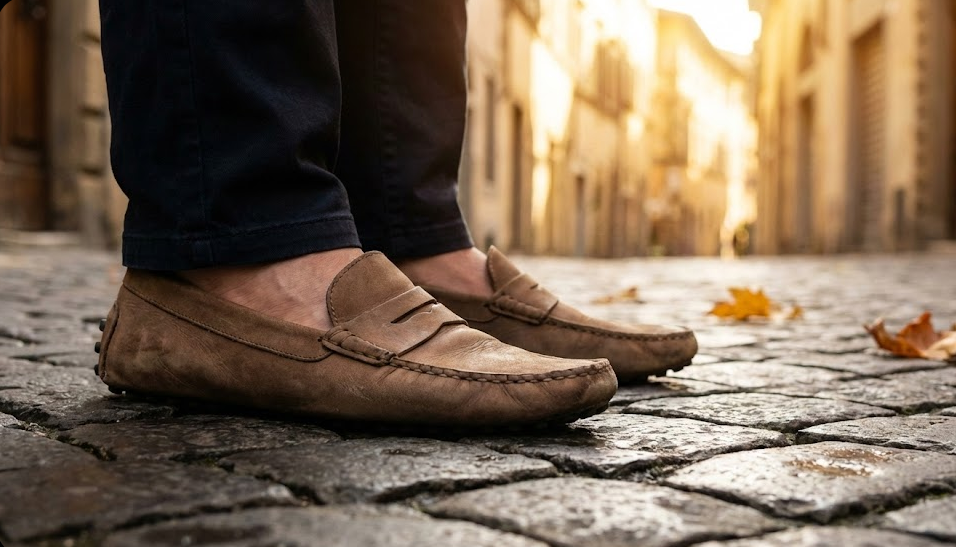
My Tod’s have scuffs now. Good. They have walked through rain in London and dust in Texas. They have character. They look better now than they did in the box. Can you say that about your plastic sneakers? Can you say that about your fast-fashion mindset?
The Investment Calculus
Let’s talk about the elephant in the room: Price.
Yes, Tod’s is an investment. But I want you to redefine how you calculate cost.
Most people calculate cost as Price at Checkout. This is a poverty mindset, regardless of how much money you make. It’s short-term thinking.
I calculate Cost Per Wear (CPW) and, more importantly, Return on Feeling (ROF).
If I buy a cheap pair of shoes for $100, wear them for six months, feel mediocre in them, and then throw them away, the cost is high. The waste is high. The psychological toll of feeling “disposable” is high.
If I buy a pair of Tod’s, I am buying into a lineage of Italian artisans who have been doing this since the early 1900s. I am buying a piece of architecture for my feet that will last years with proper care. I am buying the confidence that comes from knowing I am standing on a solid foundation.
When I walk into a room now, I don’t feel the need to shout. I don’t feel the need to prove I’m the “hustler” in the room. I let the quality speak for itself. The texture of the suede, the iconic pebble sole, the stitching—it communicates a standard. It says: “I value details. I have patience. I appreciate the process.”
In a world of noise, signal is rare.
Walk Your Own Pace
We are entering a strange time in history. AI is generating art. Algorithms are dictating culture. Everything feels ephemeral.
In this environment, being “real” is the ultimate competitive advantage. Being tactile is a superpower.
Don’t just click buttons. Feel the texture of your life. Choose things that have souls. Whether it’s the coffee you drink, the pen you write with, or the shoes you walk in.
If you are feeling lost, or burnt out, or just tired of the noise, try this: Stop running. Look at your feet. Are they planted on the ground? Do you feel connected to the earth?
Maybe it’s time to upgrade your foundation. Maybe it’s time to choose quality over speed.
It’s a long road ahead. You might as well enjoy the walk.
For those who understand that the journey matters more than the sprint, take a look at what Tod’s is doing right now. It’s not just fashion; it’s a masterclass in staying power.