

The silence in a room can be heavy, but the silence of a “cheap” room is different. It’s hollow. It’s the sound of plastic disguised as brass, of hollow-core doors that feel like cardboard, and of light switches that click with the unsatisfying snap of a disposable toy.
I was standing in my hallway last Tuesday, staring at a light switch. A small, white, plastic rectangle. It’s a thing we touch a hundred times a day without thinking. But in that moment—after a grueling twelve-hour shift of building things that exist only in the “cloud”—the sheer flimsiness of it broke me.
We spend our lives chasing “success,” yet we surround ourselves with the temporary. We live in a world of IKEA-flat-pack souls, where everything is designed to be replaced in three years. We’ve been conditioned to accept “functional” as a substitute for “substantial.” We’ve traded the tactile weight of reality for the convenience of the mass-produced.
That plastic switch wasn’t just a utility. It was a symptom. It was a reminder that I was living in a beige box, a space that didn’t care if I was in it or not.
The Beige Trap
We are taught to grind, to optimize, and to save. We are told that the “bones” of a house don’t matter as long as the WiFi is fast and the mortgage is manageable. But there is a slow, invisible erosion that happens when nothing you touch has any weight.
Choice is a muscle. If you don’t use it to define your standards in the physical world, you lose your edge in the professional one.
Most people live in a state of sensory deprivation. They touch plastic handles, walk on laminate floors, and dim their lights with sliders that feel like they’re going to snap off in their hand. We’ve been convinced that “home improvement” is about resale value, not about the visceral experience of inhabiting a space. This is a lie.
True resilience isn’t just about surviving the work; it’s about refusing to live in a world that feels like it’s made of foam and glue.
I decided I was done with the temporary. If I was going to work this hard to build a life, the physical touchpoints of that life had to be real. I needed the cold, unapologetic weight of metal. I needed the grit of a machine-turned screw.
The Real Cost
People often tell me they can’t afford to be “picky” about door handles or light dimmers. “It’s just hardware,” they say.
They are wrong. It’s never “just” hardware. How you do one thing is how you do everything. If you settle for “hollow” in the things you touch every day, you are training your brain to settle for “hollow” in your ambitions.
The “average” hardware at the big-box store is a scam. You aren’t paying for quality; you’re paying for the logistics of mediocrity. You’re paying for a product that was engineered to be as light and cheap as possible while still barely functioning. You’re paying for the privilege of being ignored by your own home.
I started looking for the edges of the design world. I wanted something that felt like it had been born in a motorcycle garage, not a boardroom. That’s when I found Buster + Punch.
It wasn’t a “discovery” of a brand; it was a discovery of a rebellion. Massimo Buster Minale didn’t start by looking at interior design magazines; he was a London architect who spent his nights building custom motorbikes. He took the knurling from a handle-bar, the solid weight of an engine component, and the raw soul of subculture, and he put it into the things we touch every day.
The Pivot
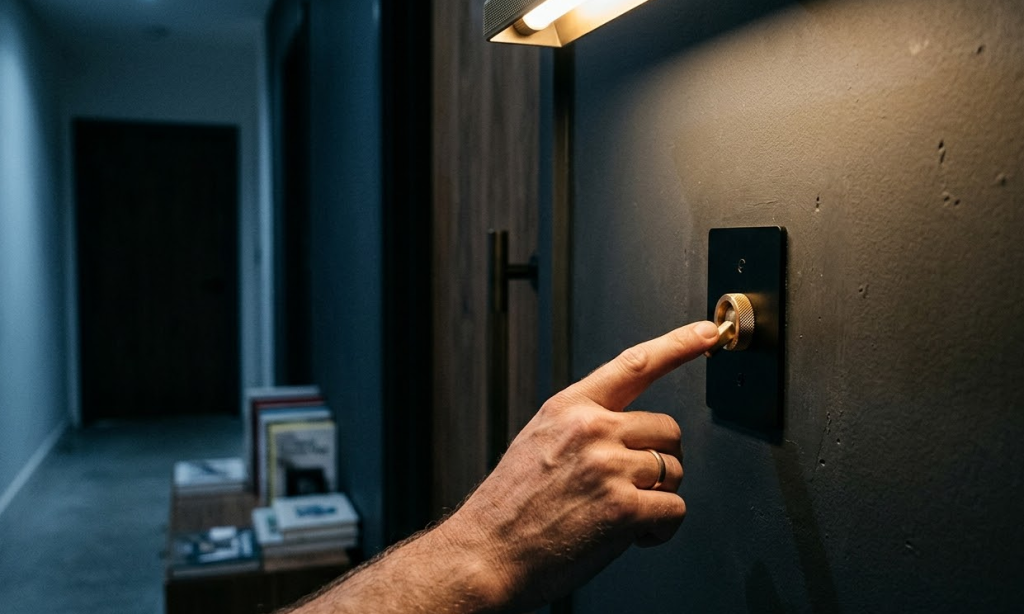
I ordered my first set of electricity toggles with a sense of “is this overkill?” But when they arrived, the weight alone answered the question. These weren’t stamped out of a sheet of tin in a factory that makes soda cans. These were solid. Heavy. Brutal.
I remember the afternoon I replaced that flimsy plastic switch in my hallway. The moment I tightened the last solid brass screw, the room changed. Not the look of it—though that was striking—but the feeling of it.
The first time I flipped the toggle to turn on the lights, it didn’t “click.” It snapped with the authority of a bolt-action rifle. It was a physical feedback loop that said: This is real. You are here. You are in control.
That is the “Life Hack” nobody tells you about: Tactile feedback is the only cure for a digital soul.
Tactical Rituals
I’ve developed a framework for this: Physical Friction as a Mental Reset. In a world that wants everything to be “frictionless” and “seamless,” we lose our sense of presence. We glide through life without ever feeling the texture of it.
I don’t “save” the quality for the guest room. I put it where I touch it most. The kitchen handles. The bedroom light switch. The door to my office.
If you wait for a “total renovation” to treat your space as something of value, you’re just reinforcing the idea that your current life is a temporary slog. That is a fast track to a soul that feels like a rental.
Now, my ritual is simple. When I walk into my office to start a brutal day of work, the first thing I do is reach for the Buster + Punch handle. It’s cold. The knurling—that cross-hatched pattern from the world of precision engineering—bites slightly into my palm. It wakes me up. It reminds me that I am about to do work that has weight.
The Truth
The secret isn’t about “luxury”; it’s about the purpose of the material. I’ve outsourced the engineering of my environment to people who understand that metal has a soul.
When I flip a Buster + Punch switch, I’m not just turning on a bulb. I’m supporting a lineage of makers who believe that subculture, music, and raw materials belong in the home. I’m connecting with a philosophy that says “functional” should also be “fierce.”
My work has changed since I made this shift. My standards for my own output have risen. I find myself looking at a half-finished project and saying, “This feels like a plastic light switch. It’s safe, it’s flimsy, and it’s not good enough.” I tear it up and start over. Because if I won’t settle for a hollow door handle, why would I settle for a hollow career?
The Choice
We only get a certain number of days in the spaces we build. You can spend them being managed by your environment, or you can spend them commanding it, one solid metal touchpoint at a time.
Stop settling for the flimsy swill of the mass market. Stop being a victim of “good enough.” The world is full of incredible, gritty, beautiful things made by people who are just as hard-core as you are. You just have to be willing to look further than the local hardware store.
I’m back in my office now. The hum of the digital world is still there, but I’m not a cog anymore. I reach out and flip the solid brass toggle. Snap. The light is on. I am here.
It’s time to stop settling for the beige. You’ve earned the right to feel the weight of your own life. You’ve earned the right to be real.